Positioning and information architecture
What the company is for, and which pages prove it. Built for a long, considered sale where the buyer does most of the evaluating before they contact you.

Norml is an AI web design agency in the literal sense: we design and build the websites and products of AI and machine-learning companies. For teams selling a complex, high-budget capability to technical founders, CTOs and heads of engineering, who research carefully and decide long before they ever book a call.
A few clients we’ve worked with










The buyer is a skeptical engineer who has to believe you are an established, capable partner within the first few seconds, and then keep believing it.
The capability is genuinely hard to explain, and every attempt either loses the technical reader or says nothing.
The portfolio is a grid of logos, when what a technical buyer wants is the specific proof from one named engagement.
The brand is a logo and two flat colours, which cannot carry an enterprise sales conversation on its own.
The category moves every quarter, and the site describes a positioning the company has already outgrown.
Eight things, in the order we do them. Web design for AI companies starts with the capability you actually ship and the evidence a technical buyer actually asks for; Norml can take the whole scope or work beside your team.
What the company is for, and which pages prove it. Built for a long, considered sale where the buyer does most of the evaluating before they contact you.
The capability explained in the buyer’s terms without being softened into marketing. Written against what the system actually does, with your engineers in the room.
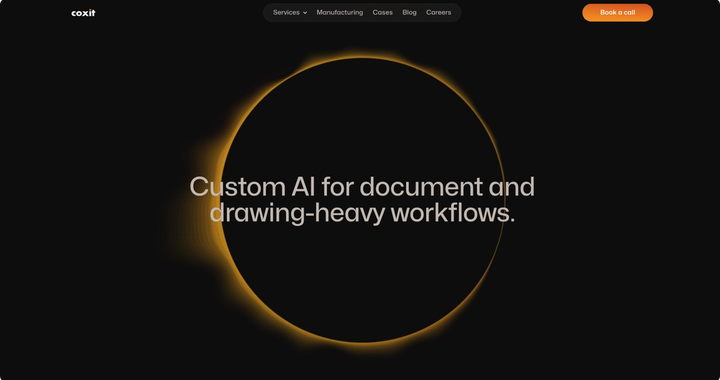
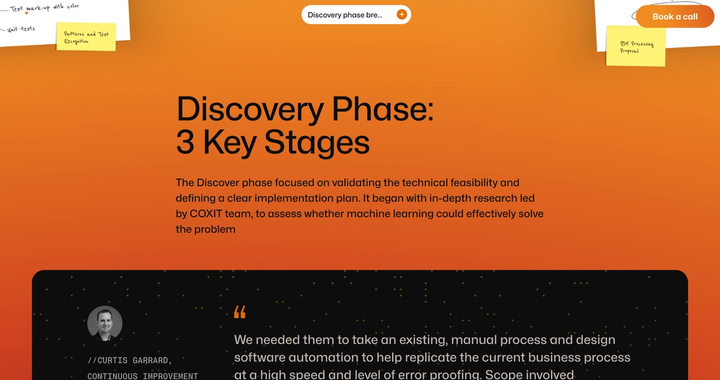
For Coxit we built a content model with its own template per named engagement, so each story carries the specific proof points a technical buyer cares about instead of being flattened into one layout.
Components, states and responsive rules — and where the brand is thin, the identity to hang them on. Coxit went from a logo and flat palette to photography, an illustrated icon set and card modules carried through to print.
When the thing being sold is the product itself. For Stevens Industries we designed the flow where a user uploads complex architectural PDFs and receives an automated estimate, plus the AI chat that answers questions against those documents.
We use AI in production and publish what we measure about it rather than claiming it as magic. It shortens research, first drafts and asset work; it does not decide the architecture, and a person stays accountable for everything that ships. That is the difference between AI web design done by a studio and a page a generator produced.
A blog with real SEO fields and internal linking, FAQ and CTA components, and the research behind them — keyword research, a technical audit, a content pipeline — so publishing does not stop on launch day.
WordPress or a Next.js front end, structured so a new service or industry page is an extension rather than a rebuild. Coxit’s content manager publishes posts and roles without a developer.
The exact scope depends on whether the job is the marketing site, the product, or both. A typical engagement hands over the following:
A page map you can hand to anyone — every URL, its job, and what links to it.
A Figma design system with components, states and responsive rules.
A case-study template per named engagement, carrying real proof points.
Page content written against the capability as it ships.
A built site your content team can extend without a developer.
Product interface design where the product is part of the scope.
Analytics and Search Console configured on day one, not after launch.
A handoff session and the files, so nothing about the site depends on us staying.
Our process
We read the product, the analytics and the sales calls, with your engineers rather than around them. You get the diagnosis — where a technical buyer stops believing you.
[ 01 ]Page map, URL structure and what each page has to prove. A sitemap you can argue with before anything is designed.
[ 02 ]Wireframes first, then the system in Figma. Components and states, not a stack of static screens.
[ 03 ]WordPress or Next.js, structured for extension. Where the product is in scope, the interface is prototyped and tested before it is built.
[ 04 ]Redirects, analytics, Search Console, speed, and the content pipeline running rather than planned.
[ 05 ]