Optional analytics, advertising and case-study videos are off. Allow them all, or open settings to choose. Privacy policy
Visit website

3,000+
6
4
40%
Designing and building an AI research platform for financial professionals comes with specific challenges. Here's what the team ran into — and how each was addressed:
Query ambiguity. Financial questions are often ambiguous — the same term can mean different things in different contexts. Solved with query parsing, key-term caching, and predefined templates per user role.
Text-to-SQL accuracy. Generating accurate database queries from natural language is hard. Solved with schema-driven prompts, query validation, and a feedback loop to catch incomplete results.
Model reliability. AI models can produce confident but incorrect answers. Solved by keeping each agent narrowly scoped, requiring source citations, and monitoring outputs.
Data scaling. Processing data for 3,000+ companies daily at scale. Solved with an automated pipeline using AWS EventBridge, SQS, and Lambda with retry logic for failed jobs.
Multi-agent context. Agents need to share context mid-query — if one finds something relevant, the others need to know. Solved by passing enriched context explicitly between agents through the orchestrator.
In the discovery phase, Norml ran persona research, feature mapping, information architecture, and a clickable Figma prototype. The next stage was to bring that prototype to life: a working MVP that could handle real financial data, answer research questions, and be tested by actual analysts. We worked in two-week cycles with regular client demos to keep priorities aligned.
The platform combines a multi-agent AI system with an automated data pipeline that monitors 3,000+ US securities daily. It came together in three stages:
Data infrastructure — an automated pipeline connects four data sources: financials, stock prices, macro indicators, and regulatory filings, covering 3,000+ US companies.
AI agent system — rather than one model doing everything, specialized agents work in parallel: one tracks news, one checks financials, one handles valuations. A lead agent coordinates the team and delivers a single, combined answer.
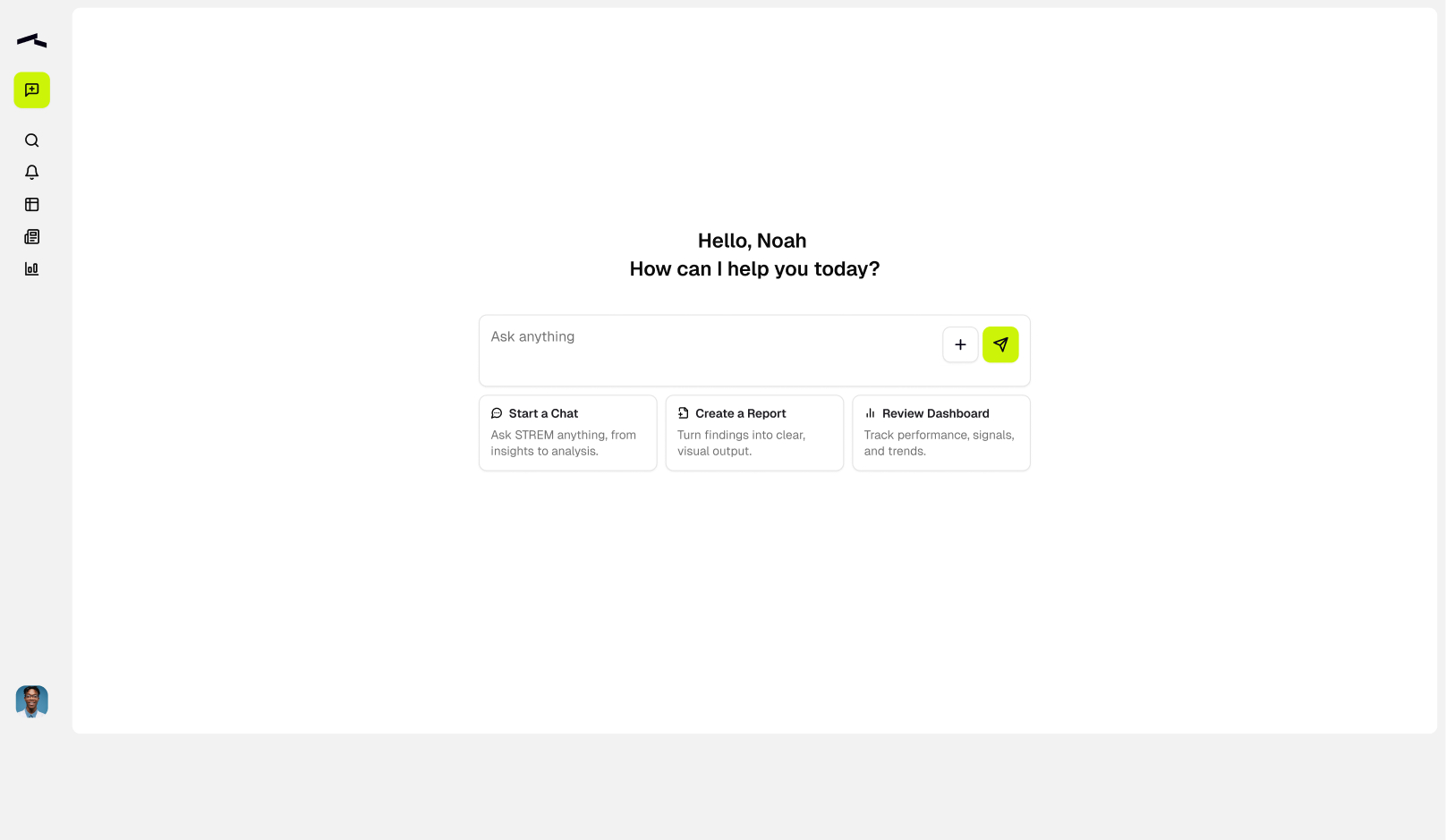
Platform and core workflows — one unified workspace replaces fragmented dashboards. Built around a central chat, it includes a company dashboard with filings and news, a cross-company news feed, watchlist and coverage management, and report export to PDF and Excel.
Watch the full demo — a walkthrough of every core feature.
The first MVP iteration is a working prototype designed to help analysts work faster and reach more valuable information. We kept the interface minimal and prioritized three core features, so the product could be tested with users as early as possible and refined from their feedback.
At the center of the platform is a natural-language interface that acts as a specialized financial assistant. Analysts ask questions in plain English, and the AI pulls from real-time financial data, SEC filings, and news to deliver precise, citation-backed answers — connecting raw data to instant insight and cutting routine research time.
This is where Strēm separates itself from generic AI tools. Analysts build a Coverage list by tracking companies, assigning strategic positions, and adding personal investment notes. The AI remembers this context, so teams can run retrospectives on past predictions and compare positions against market benchmarks. Because context is shared at the company level, portfolio managers and researchers can see each other's insights — turning individual analysis into collective intelligence, and a competitive advantage.
An automated news pipeline runs continuously. News appears inside the active Research chat, in dedicated company dashboards, and in a standalone feed. Alerts tie directly to a user's Coverage list, proactively flagging only the events that affect the securities they track — so analysts spend less time scanning and more time deciding.