Specifications are reachable
A catalogue structured around what things are and what they do lets a technical buyer find the right item without an email.

Norml designs and builds the websites of manufacturers and industrial suppliers. The architecture, the design system, the build, and the document and quoting work behind it. For companies whose buyers are engineers and procurement, comparing specifications rather than reading about values.
A few clients we’ve worked with









Manufacturing website design for industrial companies — product and capability architecture, spec-heavy pages, and the quoting and document work behind the enquiry.
The catalogue is real and deep, and the site shows a handful of product families with no specifications.
Every enquiry is "contact us for a quote", so the buyer compares the two competitors who published a number.
Datasheets and drawings live in PDFs that nothing can read and nobody can find.
The site was built for a distributor audience, and half the traffic is now end buyers.
Decades of product history exist and the website describes the current catalogue only.
Industrial buying starts with a specification, not a brand. The site either helps an engineer confirm you can make the part, or it stops being considered.
A catalogue structured around what things are and what they do lets a technical buyer find the right item without an email.
Capturing the specification with the enquiry removes the week of back-and-forth before anyone can price the job.
Two audiences with different questions can share one site when the structure accounts for both instead of averaging them.
Seven things, in the order we do them. Web design for manufacturing starts with the catalogue and the real enquiry path; Norml can take the whole scope or work beside your engineering and sales teams.
How the range and the capabilities are grouped, what a product family page has to prove, and how a buyer with a specification finds the part that matches it.
Tolerances, materials, dimensions, certifications, in structured fields rather than buried in a PDF. Comparable is the whole point.
A document layer with real search and real metadata, so a drawing is retrievable by part rather than by asking someone in sales.
Components, states and responsive rules, so a new product family looks like the rest and does not need a designer.
Conditional forms that capture the specification with the enquiry, routed into the CRM with the right owner, so sales opens a brief rather than a blank message.
WordPress your team can edit, or a custom application where the catalogue needs one, including moving off an inherited site without losing the rankings it has.
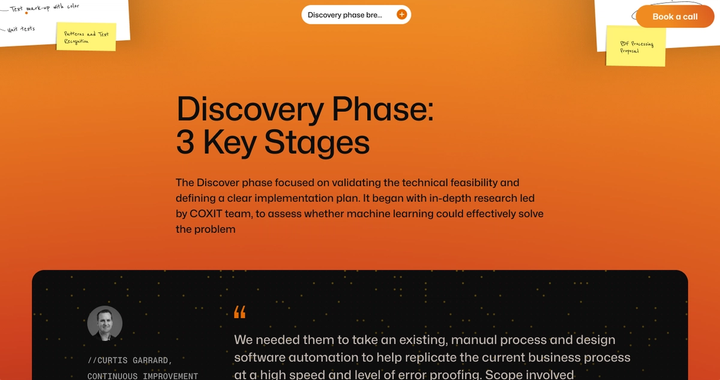
For Stevens Industries the job was software, not a website: a platform where estimators upload architectural PDFs and get automated counts, with an AI chat for querying the documents. Their manual review ran two to six hours; with the model in place it runs in under ten minutes.
Reviews from the companies we have built and maintained websites for.
Read every review on Clutch“They delivered what they said they would, on time.”
“We didn’t choose them to be impressed — we chose them because we knew they’d deliver high-level results with no risk. As a CTO myself, that’s exactly what I look for in a long-term partnership.”
“And, you know, the great part about the fact that you hit the goal, it's not that you had to compromise anything that you were doing, because, honestly, the end result far exceeded what we could have imagined.”
“I would just say that you deliver on quality … I just thought we clicked, and you delivered what we were looking for.”
The exact scope depends on the catalogue and the channel mix. A typical engagement hands over the following:
A product and capability map covering every page, its job, and what links to it.
A Figma design system with components, states and responsive rules.
Specification templates with structured fields rather than prose.
A document layer where datasheets and drawings are searchable.
Enquiry and quote forms wired into your CRM with routing.
A built site your team edits without a developer, plus a redirect plan.
A handoff session and the files, so nothing about the site depends on us staying.
Our process
We read the catalogue, the analytics and the enquiries sales actually receives. You get the diagnosis — what buyers cannot find and what it costs.
[ 01 ]Product and capability structure, URL plan, and what each page has to prove. A map you can argue with before anything is designed.
[ 02 ]Wireframes first, then the system in Figma. Specification and family templates, not a stack of static screens.
[ 03 ]The site, the document layer, and the quoting flow behind it. Editable by your team.
[ 04 ]Redirects, analytics, Search Console, speed, and enquiry tracking live from day one.
[ 05 ]No account layer between you and them. These are the Norml specialists this work runs through.

Founder & Architect

Co-founder · Design & Strategy

Full-Stack Developer

Full-Cycle SEO Specialist

QA Engineer

“I've spent 10 years working across development and marketing. I started as a developer, but design, SEO and advertising were already part of the job. That taught me to treat a website as one system: the business, the content, the design and the code have to work together. At Norml, I lead the architecture behind our work and stay involved wherever strategy, design, development and search meet.”
Max TymoshynFounder & Architect
Get started